Showing posts with label DOPA. Show all posts

Sunday, March 21, 2021

2020 statistics

 Last week, DOPA published their annual statistics with the numbers of the various subdivisions. The only changes are in the numbers of the local governments due to some municipal upgrades and merges. Interestingly, no new administrative villages were created last year.

Also included in the graphic posted to Twitter and Facebook is the population number. The detailed numbers can be found at stat.dopa.go.th, also there already was the annual Royal Gazette announcement with the numbers by provice.

  • Changwat: 76
  • Amphoe: 878
  • Tambon: 7255
  • Muban: 75086
  • PAO: 76
  • Thesaban: 2472 (2450)
    • Thesaban Nakhon: 30
    • Thesaban Mueang: 195 (184)
    • Thesaban Tambon: 2247 (2236)
  • TAO: 5300 (5324)
  • Special administrative units: 2
And, as usual, I still don't believe the Tambon number, which should be 7256 according to all other sources.

Wednesday, March 4, 2020

Number of administrative units 2019

The Department of Provincial Administration has published the latest statistics of the numbers of administrative units in Thailand, as of December 31st 2019. The numbers are as follows, with the 2018 numbers in brackets if there were changes.
  • Changwat: 76
  • Amphoe: 878
  • Tambon: 7255
  • Muban: 75086 (75032)
  • PAO: 76
  • Thesaban: 2450 (2442)
    • Thesaban Nakhon: 30
    • Thesaban Mueang: 184 (179)
    • Thesaban Tambon: 2236 (2233)
  • TAO: 5324 (5332)
  • Special administrative units: 2
After some years of almost no changes, now there are some new administrative villages, and also the number municipality upgrades have increased - and several more are in the pipeline, as I have noticed them in the meeting transcripts at law.moi.go.th. And as usual, there is still the odd discrepancy of one subdistrict which is not counted in this statistics, but still included in the population data.

Wednesday, February 20, 2019

Number of administrative units 2018

The Department of Provincial Administration has published the latest statistics of the numbers of administrative units in Thailand, as of December 31st 2018. The numbers are as follows, with the 2017 numbers in brackets if there were changes.
  • Changwat: 76
  • Amphoe: 878
  • Tambon: 7255
  • Muban: 75032
  • PAO: 76
  • Thesaban: 2442 (2441)
    • Thesaban Nakhon: 30
    • Thesaban Mueang: 179 (178)
    • Thesaban Tambon: 2233
  • TAO: 5332 (5333)
  • Special administrative units: 2
There is only one change recorded, an upgrade of a TAO to a town municipality - which is the upgrade of Bang Khu Rat in Nonthaburi province. I haven't yet reported it on here, and in fact it was effective January 2nd 2019, so claiming the numbers are as of December 31st is not fully correct. As all other numbers stayed identical, it only shows that currently there's almost no activity concerning the administrative units. And as usual, there is still the odd discrepancy of one subdistrict which is not counted in this statistics, but still included in the population data.

One interested side-note - this year the document includes an English version, which I haven't seen before.

Friday, March 16, 2018

Infographics

The fact that a good graphical display of data is usually more important (and more difficult) than the collection of the bare data was one thing I learned from the talks in the Wikidata Con last year. Sadly drawing things myself is something I have no talent at all, but lately two of the Facebook feeds I read started to post nice infographics almost daily, of which I will present two here.

Entity number as of 2017-12-31
Source: DOPA fanpage
The DOPA fanpage posted the graphical display of the 2017 entity numbers I presented here earlier this month. Of course the numbers are the same, it being displayed this way of course looks more catchy than the plain table I posted. I don't get why they chose to display mountains for the central administrative units, and their height totally not matches the numbers. For the local administrative units, it was of course very difficult to find any icon to symbolize the Provincial Administrative Organizations (PAO) - it's already difficult to explain the function of those to someone not familiar with the Thai administrative system, and guess many Thai don't know about them either.

Labor force survey 2018-02
Source: NSO
The second graphic is from the facebook feed of the National Statistics Office (NSO). Most of the infographics there are of course in Thai only, but at least one they also posted in an English translation - the Labor Force Survey of February 2018. It shows interesting factoids like the numbers of employees by sector (agriculture still dominants) or the unemployment rate by education - interestingly Bachelor degree holders have the highest unemployment. Would of course be nice if they'd post translated graphics more often.

While these graphics are great to catch the eye and give information to the reader, they have one big drawback - they are inaccessible to search engines. Textual data can be easily indexed and then found again later, PDF files are already more difficult especially if the raw text isn't embedded and must the retrieved by OCR, but these pure graphics won't ever be found by Google unless they implement much more artificial intelligence into their crawler.

Friday, March 2, 2018

Entity numbers as of December 31st 2017

To round up the annual statistics announcements, today the Department of Provincial Administration did publish the numbers of administrative units. The numbers are as follows, with the 2016 numbers in brackets if there were changes.
  • Changwat: 76
  • Amphoe: 878
  • Tambon: 7255
  • Muban: 75032
  • PAO: 76
  • Thesaban: 2441
    • Thesaban Nakhon: 30
    • Thesaban Mueang: 178
    • Thesaban Tambon: 2233
  • TAO: 5333 (5334)
  • Special administrative units: 2
The only change at all is that one subdistrict administrative organization is gone, which was the merge of Wang Nua TAO and municipality. And as usual, there is still the odd discrepancy of one subdistrict which is not counted in this statistics, but still included in the population data.

Thursday, January 18, 2018

Population pyramid for Thailand

A German-language news post about a recent cabinet decision trying to increase the birth rate reminded me that I wanted to post about the age distribution in Thailand already. The DOPA statistics page has the age distribution for every year since 1993, and even not just for the whole country but down to subdistrict level. Though my Excel skills aren't that great, I managed to build a automatically calculated graphic.
Age pyramid 2017
One can clearly see in this pyramid that the Thai population is aging, and the number of births has decreased a lot. There are two bulges, one of births around 1970 and a smaller one for births around 1995 - maybe simply those from the 1970 bulge having children at that time. The pyramid is not much different from that of the industrialized countries in Europe.

I am currently adding the national age pyramid data from those DOPA statistics into my XML, and since it is probably easier to use for non-technical users also add them into a spreadsheet. The census reports also include age distribution data, but so far I have only typed in a small part of those - the one from DOPA can be done with copy-and-paste and just a little manual work.

Tuesday, January 2, 2018

Population data 2017

Directly on New Year, the population data as of December 31st 2017 was made online on the DOPA website, giving the population numbers for each province, district and subdistrict. Sadly, its not possible to link to the actual data for the whole country directly, only for each province - however, the age distribution page also shows the total population numbers.

The total population has increased to 66,188,503, an increase of 256,953 or 0.4%. One percent of the registered population are foreigners. As one can see in my spreadsheet with the numbers at province level, the biggest increase by percent was in Samut Sakhon by 2.1%, in fact all of the provinces around Bangkok gained whereas Bangkok again lost a little.
Population development since 1993
(decrease in 2004 was data correction)

As a little side-note - the population data for Saphan Sung district finally gives the codes for the two new subdistricts which were forgotten in the latest update of the ccaatt spreadsheet - Rat Phatthana got the 104402 and Thap Chang the 104403. I still have to look through the data to check whether any municipality got a new code additionally to those already in the October update.

Another thing I still have to look into is the fact that at least for some months already, the population data no longer stops at the subdistrict level but also includes the administrative villages. However, as this means a tenfold increase of data (and thus download time, and XML file size) this creates some technical problems with my processing - besides the fact that the Muban data is a bit odd in some cases I have looked into so far.

Wednesday, April 5, 2017

Number of administrative units 2016

Last month, the Department of Provincial Administration announced the numbers of administrative units as of December 31 2016. The announcement - titled แจ้งข้อมูลทางการปกครอง ณ วันที่ 31 ธันวาคม 2559 - gives almost the same numbers as one year ago.
  • Changwat: 76
  • Amphoe: 878
  • Tambon: 7255
  • Muban: 75032 (74965)
  • PAO: 76
  • Thesaban: 2441
    • Thesaban Nakhon: 30
    • Thesaban Mueang: 198
    • Thesaban Tambon: 2233
  • TAO: 5334
  • Special administration: 2 (Bangkok and Phattaya)
The only number which changed were the administrative villages, adding 66 Muban. Exactly the same number were announced in the Royal Gazette last year, all from the Ministerial Order มท ๐๓๑๐.๑/ว ๗๔๖๕. Though actually, eleven of those Muban already became effective before December 31 2015, but these were not yet included in the numbers last year. In my XML I have 75153, as some Muban in municipal areas seem to have been abolished, but without a current official list I have no idea which. And as usual, there's the odd missing Tambon, the correct number should be 7256.

Friday, February 12, 2016

Population statistics 2015

Last week, the Department of Provincial Administration officially published the population numbers as of December 31st 2015. The reason why I said officially - the numbers were actually already available before January 18th, when I downloaded them and added them into my XML structure. I even added them in several WikiData items already. Sadly, the actual population data is only linkable at province and district level, the one for the whole country needs a POST call and thus cannot be linked, so can only be reached from the DOPA website itself.

As usual, this population number only includes the registered Thai residents, and since often Thais are still registered at other places than their actual residence, these numbers are to be taken with care. The census data however is supposed to list the actual residence, and also includes foreigners. Anyway, according to this statistics
  • Thailand has a population of 65,729,098, of which 32,280,886 are male and 33,448,212 female.
  • Compared to 2014, the population has increased by 604,382 or 0.9%.
  • Bangkok remains the most populous province with 5,696,409 citizen, followed by Nakhon Ratchasima with 2,628,818 and Ubon Ratchathani with 1,857,429 (Chiang Mai is only the 5th).
  • The least populated provinces are Ranong with 187,536 and Samut Songkhram with 194,376 citizen.


Only other thing which I noticed during the download - the subdistrict municipality Klet Kaeo (เทศบาลตำบลเกล็ดแก้ว) in Chonburi province now has received its own geocode 2060, which is not yet listed in the CCAATT list.

Friday, April 24, 2015

@amphoe

The Department of Provincial Administration is starting a new public relations magazine named @amphoe, which seems to be part of their project Amphoe Yim (อำเภอยิ้ม, smiling district) running for some years already. Right now the first issue is only available in digital form, and if I understand it correctly the printed version will be out middle of May. They also did a Facebook page to promote this magazine.

The magazine is of course predominantly in Thai, but there are a few pages with English text as well, e.g. on page 23 a section named "Things you may not know about administration" includes the answer why there are only 76 provinces and not 77 as many wrongly believe. Though I cannot read much of the Thai text, the paper version would be a nice addition to my library. Anyone could grab me an issue and I will pick it up when I am in Thailand again in July?

I am not sure if this new magazine will replace the long-running Thesaphiban magazine also published by DOPA, or will be a more general-public supplement.

Monday, January 12, 2015

Population statistics 2014

Last year, the format of the population statistics on the website of DOPA changed significantly. Until 2012, there were static HTML files with all the data, but now it has been changed to pages using Javascript and retrieving the actual data with JSON requests. I still haven't finished writing the posting on the technical details of this new system and its pros and cons. But apparently one big pro of the new system just showed up now.

In past, these statistics usually came online in April, though the data dated from December 31 of the previous year. Don't know which processes made it take so long, since converting the data into HTML pages shouldn't be much difficult with some programming. To my big surprise, in the new statistics system the data for 2014 already showed up on January 10, or maybe even earlier as I didn't checked it before. Maybe now this new system is directly connected to the database containing the source data.

The total population of Thailand increased from 64,785,909 to 65,124,716, an increase of 338,807 or 0.5%. I still have to adjust the code to calculate the biggest gainer and looser to work with the new population data format, instead I show the graph of the DOPA population data since 1993. Except a big drop in 2004 - apparently due to a big registration data cleanup - there's a steady increase with around 0.5% for several years already.

Monday, August 19, 2013

DOPA entity numbers 2013

Though it was already published in April, I didn't noticed the annual list of numbers of the administrative entities until few weeks ago. This latest list as of December 31st 2012 states the following numbers.
  • Provinces (Changwat, จังหวัด): 76
  • Districts (Amphoe, อำเภอ): 878
  • Subdistricts (Tambon, ตำบล): 7255 (though I believe the correct number is 7256)
  • Villages (Muban, หมู่บ้าน): 74,963
  • Provincial administrative organizations (PAO, อบจ): 76
  • Municipalities (Thesaban, เทศบาล): 2266
    • Cities (Thesaban Nakhon, เทศบาลนคร): 29
    • Towns (Thesaban Mueang, เทศบาลเมือง): 167
    • Subdistrict municipalities (Thesaban Tambon, เทศบาลตำบล): 2070
  • Subdistrict administrative organizations (TAO, อบต): 5509
  • Special administrative units (องค์กรปกครองส่วนท้องถิ่นรูปแบบพิเศษ): 2
Compared with the data from 2012, there is of course no change in the central administrative units except seven newly created administrative villages (all where published in the Royal Gazette: one in Chumphon, three in Tak, two in Lampang and one in Yala). The number of municipalities increased a lot again by 184, and will do so in this year as well, so I will skip to check those numbers with my data for now and wait till the list of upgrades for this year is complete.

Tuesday, July 30, 2013

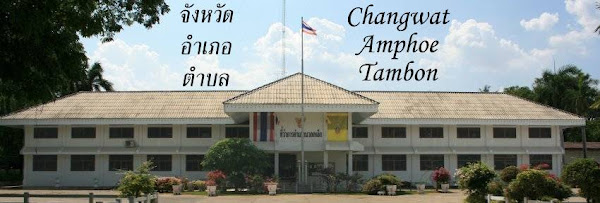
How many tambon are there in Thailand?

I always thought that the question on the number of Tambon (subdistrict) is a trivial one, as several government publication list the number of subdivisions, and they all consistently give a number of 7255 (or 7424 if including the subdistricts of Bangkok, which however actually are a different type of administrative unit) - for example the 2012 list from DOPA, or the 2013 list I didn't noticed yet. I never questioned that number, as I thought the department within the Ministry of Interior would know their numbers well.

But now I am in email contact with someone who has compiled his own lists of municipalities and subdistricts, and then cross-checked then with my spreadsheet. Quite helpful, it showed several cases where I had small mistakes within my lists, as well as clearing up some in his lists. He had a few more subdistricts in his list than me, and I also had a subdistrict named Som Kai (ตำบลสมก๋าย) in Chiang Mai listed as an active subdistrict, even though it was one which was not created, but got a the geocode 50061400 assigned already. But after removing that one, I noticed I still have one subdistrict too much - the corresponding sheet had 7425 subdistricts, thus 7256 Tambon.

Checking with the population numbers from DOPA, the additional Tambon stayed, apparently there are 7256 populated Tambon. Next step then was to check with a Excel sheet showing the subdivision numbers for each province, which also had 7255 Tambon altogether - and with that one I could nail it down to be Nakhon Si Thammarat province to have the additional subdistrict. According to that spreadsheet (and several other sources), the province has 169 Tambon - actually a lot of source show a number of 165, even the website of the province administration itself, which is even more wrong. But I have 170 Tambon, and with a 2003 book listing all the Muban I was able to find the culprit - Pak Phanang district is listed there without the subdistrict Pak Phanang (ตำบลปากพนัง). The only thing special about that subdistrict is the fact that it is completely covered by the town Pak Phanang (เทศบาลเมืองปากพนัง), and thus has no subdivision in to Muban anymore, nor any village or subdistrict headmen. But that is not unique to this Tambon, there are several of this kind in larger towns or cities. In fact, the subdistrict was identical with the area of the town until the town was enlarged in 1993 [Gazette].

Center of Pak Phanang district in 2003
With two offices within DOPA contradicting already, I wasn't able to find any more solid proof in either direction. amphoe.com for example includes a map showing the Tambon of Pak Phanang with only 17 Tambon, even the Royal Gazette is no help - obviously there is no announcement abolishing this subdistrict, but an announcement from 2003 defining the boundaries of the subdistricts again only lists 17 subdistrict. Another announcement from the same year however on land expropriation includes a map which shows this subdistrict.

If anyone can help to clear up this confusion I would be happy, so far I can only find that something is very odd around there.
Friday, April 12, 2013

Population statistics 2012 available

End of March, the official population numbers as of December 31 2012 were published in the Royal Gazette, listed for each province. According to this announcement, the Kingdom has a population of 64,456,695 - 32,700,727 men and 32,755,968 women.

More detailled is the population statistics which is available at the Department of Provincial Administration (DOPA), which goes down to subdistrict level and also separated municipal and non-municipal data. I have written down a guide on how to read these data earlier on the blog. The full 2012 data is now also available - with the usual caveat that this data relies on the registration data, but quite a lot of Thai don't renew their registration when they move to a different province, so especially the numbers for Bangkok are probably much lower than the real population.

A little picks from the data
  • The population for the whole country increased by 380,662, which means an increase by 0.59%.
  • The province which had the largest population increase was Chonburi, which gained 25,346 citizen. By percentage however, Pathum Thani was the biggest winner with a 2.27% increase.
  • Tak lost 4,973 citizen, which also made it the biggest looser by percentage with a 0.94% loss.
  • At district level, Mueang Samut Prakan district had the largest increase by number (7,556), whereas Bang Yai in Pathum Thani the largest by percentage (4.46%).
  • At subdistrict level, the largest increase by percentage was on Ko Tao (25.21%), the largest decrease in Mae Sot (-12.49%)
Usually the population data contains some new municipalities as well, however by far not all of the municipalities created lately are listed with the data - and also those municipalities added were already created four years ago. One reason for this is obviously that in many provinces the TIS:1099 codes at district level are all used and its no longer possible to assign such a number to a the new municipalities.

Wednesday, April 25, 2012

DOPA headmen magazine

Cover 10/1998
Some years ago, I posted about the Thesaphiban magazine published by the Department of Provincial Administration (DOPA) as its internal magazine to reach all the various offices in a less formal way. Now by some random googling I have noticed that there is a second similar magazine, also published by DOPA but targeted to the lower admninistrative levels - the village and subdistrict headmen.

This magazine, titled "กำนัน ผู้ใหญ่บ้าน" (Subdistrict headman, Village headman) is also a monthly magazine, first published on December 5 1949. Sadly, it seems it is only available in paper copies, I haven't been able to see any downloadable PDFs of it. All the online information on it is rather well hidden on the DOPA website, and very outdated - from the starting page on the magazine one can only find the covers and table of contents of the years 1998 and 2002. But the magazine is still in print, just few days before I discovered the magazine, the Public Relation Department issued a short advert with the details on how to subscribe. Thus the magazine costs 216 Baht for one year, but to subscribe or get any further details one has to call a number within DOPA - funnily at the extension number 404.

There is not much else to find about this magazine on the web, the only other interesting thing are some scans of a 1957 issue, which is apparently for sale. Though probably one could find more old issues at the Chutachak weekend market - haven't been there for long time, and never browsed through the book and magazine part of the market. Though I probably won't be able to read and understand much, I would certainly love to get one (current) issue of this magazine (and the Thesaphiban magazine)...

Wednesday, April 18, 2012

DOPA entity numbers 2012

The Department of Provincial Administration (DOPA) has added the numbers of administrative subdivisions as of December 31 2011 to their website. According to that list, Thailand now has
  • 76 provinces
  • 878 districts (not including those within Bangkok)
  • 7255 subdistricts (not including those within Bangkok)
  • 74956 administrative villages
  • 2082 municipalities - 27 cities, 155 towns and 1900 subdistrict municipalities
  • 5693 subdistrict administrative organizations (TAO)
  • 2 special administrative areas (Bangkok and Pattaya)
  • 76 provincial administrative organizations (PAO)
Compared with last year, the only change for the central administrative units was the creation of one administrative village. But since the above numbers are as of December 31, this cannot be the new village in Yala announced earlier this year, as that became effective January 17. So it looks like another village creation was done, but not announced (yet).

Of course, the bigger change was within the municipality numbers, but thanks to the documents from the Department of Local Administration I should have my data current for these already.

Monday, April 9, 2012

Population statistic 2011

As expected, the full population statistics from the Department of Provincial Administration (DOPA) for the year 2011 (2554) has become online. The main index page wasn't yet updated, so it can only be found right now in case one guesses the URL - or follows the links in this post.

However, unlike previous years the data has quite a lot of problems. The most obvious one is that the new province Bueng Kan is missing - while listed in the index page with a population of 407,634, but the pages with the district and subdistrict data are still 404. The other big problem is the big number of strange subdistrict entries. Already in past years, there were occasional subdistricts with one or two citizen added in a municipality where they actually should be found, something that in past I had interpreted as a municipal border not exactly identical with the subdistrict boundaries. However, this year a total of 33 such entries were so much wrong that my algorithm could not parse them anymore. To give a few examples
  • In Bangkok, Bang Na subdistrict (แขวงบางนา) is additionally to its correct data within Bang Na district, one male in one household is found in Bang Na subdistrict in Phra Khanong district - the district which in past contained Bang Na subdistrict (see here).
  • In Fao Rai district of Nong Khai province, the subdistrict Kut Bong (ตำบลกุดบง) is listed with a single unpopulated household, whereas Fao Rai subdistrict (ตำบลเฝ้าไร่) has 1220 citizen in just 2 households. But in fact, all of Fao Rai subdistrict belongs to Fao Rai subdistrict municipality (เทศบาลตำบลเฝ้าไร่) listed one page later, and Kut Bong is actually in Phon Phisai district (see here). Whereas Kut Bong must be wrong, the Fao Rai case may be real, as it also found in the 2010 data - maybe the two households are military barracks, which are not under the jurisdiction of the municipality.
  • In Chai Prakan district, Chiang Mai province, the subdistrict Nong Bua is listed twice, once marked with an asterisk and one unpopulated household, and a second time with the actual population. Additionally, a single unpopulated household is listed under Wiang subdistrict, which isn't within Chai Prakan at all (see here).
Except the Fao Rai case (which also made no problems for my parsing algorithm), all these strange entries must be bogus. I have not much hope it will create any reaction if I send an email with the above questions to DOPA, I guess I nevertheless should give it a try, at least to get the data for Bueng Kan.

Update:
The data for Bueng Kan showed up one day after this posting - wonder if that was a coincidence or if I have a reader within DOPA who called the right official?

Wednesday, September 28, 2011

New romanization list from DOPA

As a matter of coincidence, just one day after I posted on the strange wrong romanization of Thap Khlo district, I noticed that the Department of Provincial Administration had put a new file on their website containing a new list of transcriptions. The link is titled นามสงเคราะห์ส่วนราชการ ชื่ออำเภอ จังหวัด และตำแหน่งของปค.ภาษาอังกฤษ, which translates as "Glossary of official English names of Provinces, Districts and Positions in DOPA". Thus there are all the district and province names in English, confirming that Thap Khlo was spelled wrong in earlier publications, as well as the romanization guessed for the new district in Chiang Mai being Galyani Vadhana, following the late princess' English name and not the RTGS transcription scheme. As the title of the link suggests, the romanization of the district and province names are only one part of the document, the recommended translations of positions as well as structures within the provincial administration are an equally useful second part. I have already gone through my own glossary of terms to update the English names, Somewhat strange is the name of the head of a minor district, which is supposed to be "Minor Chief District Officer", which IMHO should better be "Chief Minor District Officer". Its however academic currently anyway, as there are no minor districts right now. Only missing in this list are the chumchon, which I would translate as borough. Only thing still missing is a new updated and corrected version of the subdistrict name transcriptions, which should also include the municipalities.

Monday, June 27, 2011

Entity number statistics

Last week, the Department of Local Administration not uploaded the list of municipal changes in the current fiscal year, they also added an updated version of their various lists, including the one with the numbers of the various local administrative units. As of June 20 2011, there are
  • 76 provincial administrative organizations (PAO), though the one for Bueng Kan isn't elected yet
  • 2010 municipalities - 27 cities, 145 towns and 1838 subdistrict municipalities
  • 5765 subdistrict administrative organizations (TAO)
  • 2 special administrative areas (Bangkok and Pattaya)
Interestingly, just now I noticed the corresponding list from the Department of Provincial Administration has been updated as well, though it was already signed on April 20. Thus, as of March 31 2011, there are
  • 76 provinces
  • 878 districts (not including those within Bangkok)
  • 7255 subdistricts (not including those within Bangkok)
  • 74955 administrative villages
  • 2010 municipalities - 26 cities, 144 towns and 1840 subdistrict municipalities
  • 5765 subdistrict administrative organizations (TAO)
  • 2 special administrative areas (Bangkok and Pattaya)
Comparing with last year, apart from the municipal changes there was of course one new province together with its PAO, and also just one new administrative village (created March 2010 in Surin).

Wednesday, February 23, 2011

DOPA population statistics 2010 now online

Thanks to the Firefox browser plugin Update Scanner, I noticed that the Department of Provincial Administration (DOPA) has uploaded the population statistics as of December 31st 2010 to their website. Well, actually not to their main website, as at that one it still has the data as of 2008, but on server still holding the old version of their website only referenced by its IP address 203.113.86.149. It was posted almost a month earlier than last year, when it appeared end of March.

Working through the data, it helped me to fix one minor bug in my software which occured in the district Wiang Nong Long of Lamphun province, one of those districts now completely covered by municipalities, and apparently the first to show in the statistics. Another thing which nearly slipped through was the fact that in Chainat the municipality Pho Nang Dam (เทศบาลตำบลโพนางดำ) was renamed to Pho Phithak (เทศบาลตำบลโพธิ์พิทักษ์) last year - and I mistakenly had the originally planned rename from the board meeting to Thep Phithak (เทศบาลตำบลเทพพิทักษ์) in the XMLs, as I failed to read the Gazette announcement well enough.

A total of 14 municipalities have been added between the 2009 and 2010 data, but only those which were already present in the latest geocode list, so I did/could not have to add any new codes to my data. Actually, this way round is the better way, I prefer to know the actual codes instead of trying to guess them from the order of entries in the statistics list. Thus there were only a few further minor points I had to change in the XML and then my software could parse the new data already. I will post some detailed analysis of the data in later posts, like the entities with largest gain or loss of population.