Showing posts with label @Amphoe. Show all posts

Friday, June 30, 2017

@Amphoe 3/2060 available

The 3rd issue of the @Amphoe magazine was just published online earlier today, right on time that I will be able to pick the paper version this one together with the other issues from the past 12 months when I will be traveling to Thailand next month.

The English language content features an interview with Boonlue Thamtaranurak (บุญลือ ธรรมรานุรักษ์), the chief district office of Galyani Vadhana district in Chiang Mai. Another part is on a new division within the Department of Provincial Administration responsible for the Hajj Affairs of the Thai Muslims, following the 3rd amendment of the Hajj Affairs Advancement Act (พระราชบัญญัติส่งเสริมกิจการฮัจย์ (ฉบับที่ ๓) พ.ศ. ๒๕๕๙) which took effect December last year.

Also, as in every issue, one province with its touristic highlights is features, this time Chanthaburi in the east of Thailand - hence the Cathedral of the Immaculate Conception on the title page of the magazine - one of the few beautiful Roman Catholic churches in Thailand.

Monday, May 22, 2017

@Amphoe issue 2/2017

This years second edition of the @amphoe magazine has been made available as a PDF file (almost 50MB size), not sure whether it was this time uploaded before it gets available in the province halls and other locations. As usual, there is some limited amount of content in both Thai and English.
  • An interview with Ms. Phumarin Khongpiantham (น.ส. ภูมารินทร์ คงเพียรธรรม), the chief district officer of Na Haeo district in Loei on the specific problems of this very remote district at the boundary to Laos.
  • The touristic highlights of Phrae province. 
  • The number of administrative units, using the graphic I also used in my coverage of that data.
  • An article on the Civil Service Day (วันข้าราชการพลเรือน) on April 1st, which includes a very short summary of the administrative reforms of Prince Damrong and King Chulalongkorn.
This summary is worth a closer look, though sadly a lot is lost in translation.
As for regional administration, mueangs were divided into mueang and amphoe monthons with samuhathesaphibans, governors and sheriffs as the leaders to oversee the well-being of the people in their respective districts. Village headmen and chiefs existed to assist the tambon- and village-level operations. [...] As for local administration, the king had the idea to have the people participate by electing village headmen and chiefs instead of having these positions [appointed].
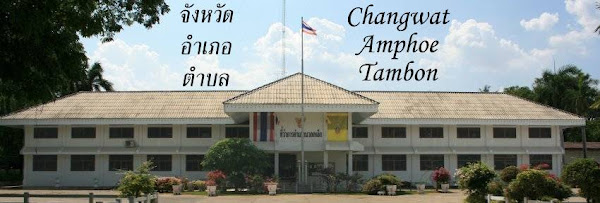
With my limited Thai and the knowledge from Tej Bunnag's book, it seems what was meant to be said is that as the Thesaphiban reforms, the country was divided into Monthon, Mueang and Amphoe, which have a commissioner (สมุหเทศาภิบาล, Samuha Thesaphiban), province governor (ผู้ว่าราชการเมือง) and chief district office (นายอำเภอ, here translated "sheriff") as the head of their administration respectively; and the Tambon and Muban as the most local divisions with the village headman and subdistrict headman (กำนัน, Kamnan, here translated as "chief") as their leader.

The Mueang became the present day provinces (จังหวัด, Changwat), the term changed in 1915, whereas the Monthon were abolished in 1933, replaced by regional administrations with much less power.
Tuesday, April 4, 2017

@Amphoe issue 12

The 12th issue of the @Amphoe magazine - dated February 2017 - has become available for download from the DOPA website. Sadly their Facebook page apparently does not get any updates anymore, so I have no idea at what time the paper version has or will become available at the province halls and some other sites.

The PDF is 48 MB big, so to download better use a fast connection. The most notable difference to the previous issues is a slight design change - now the title is in a Sans Serif font and the title photo no longer covers the full title page.

As usual, only a very limited part of the content is bilingual, this time an interview with Wittaya Khiawrod (วิทยาเขียวรอด), the district officer of Phra Phrom district in Nakhon Si Thammarat, an article on the community forestry in Rim Si Muang subdistrict of Phetchabun province, and the touristic highlights in Chumphon province - thus the title photo of a scuba diver, even though the "diving island" Ko Tao actually belongs to Surat Thani province.

Monday, January 16, 2017

New issues of @amphoe

The Facebook page of the @Amphoe magazine did not get any update since September, and at about the same time the @amphoe page at the Department of Provincial Administration disappeared. Both made me assume that this magazine quietly was shut down after just nine issues. Thus it was kind of a surprise when I tried to look again the DOPA website and it suddenly not just worked again, but showed two new issues already.

Issue 10 (5/2559) has an interview with the chief district office of Phop Phra in Tak, Prasong La-on (ประสงค์ หล้าอ่อน), talking on the special problems of the rather remote district. The 200,000-baht-per-village project is the topic of another English section, as well as a short list of the travel highlight of Mukdahan province - hence the title photo of this issue showing the special rock formations in Phu Pha Thoep National Park.


Issue 11 (6/2559) is a special issue with the late King as its only topic. As far as I can see the content hardly concerns the Amphoe administration at all, and there is no English content this time. Given the immense popularity of the King as well as the publisher being a government department its no wonder they choose to publish one special issue.

And to do my usual nitpicking - the URL advertised in the magazines www.dopa.go.th/amphoe returns a 404 error, the URL which works is atamphoe.dopa.go.th. Also apparently the process to create the PDF files has been changed, now these are only containing graphics and no text elements anymore, which has increased the file size by a factor of 8 and now makes it completely impossible to copy any content to Google Translate. And sadly, still issue 8 (3/2559) is missing in the download page, the later issues are wrongly numbered.

Tuesday, August 16, 2016

My @amphoe collection

Some of the souvenirs I brought back from my recent visit in Thailand was the completion of my @amphoe collection. When I visited last year, the first issue was just out and the second came out while I still was in Thailand. Thanks to my brother in law, I did not miss the issues published in the meantime - he went to the province hall in Surat Thani every two months to collect one magazine for me. Even though the magazine is also available online - and even available online before the print version comes out - I am old-fashioned and still like to have the paper version as well, and now I have all seven issue published so far.

And even more special is the shirt - when we picked issue number two last year,  my family noticed a competition on the back-side of the magazine and directly my mother-in-law posed in front of the province hall with the magazine in hand. And she won and got that shirt for reward and gave it to me, as I am the one who is crazy about the Amphoe...

I will certainly keep on checking their Facebook page for the next issues, even though I can only read the small bilingual section that always contains some interesting facts. And hope next year I will be able to show an even larger collection.

Thursday, February 18, 2016

Origin of the name "Sala Klang"

Issue 5 of the @Amphoe magazin is available online now, and probably being available in print very soon. In their section "Things you may not know about Administration" (Page 21), they quote from the book "Thesaphiban" by Prince Damrong, father of the administrative system still in use today.
However, the governor’s home differed from other people's homes in being in a highly secure area centered on the governor's home known as a chuan. As such, government business would be conducted in a large pavilion on nearby grounds outside the bulwarks surrounding the governor's residence. This pavilion became known as the sala klang ("central pavilion").
Several of these former governor homes have been preserved, and at least two of them can be visited - the National Museum in Songkhla is in the former residence of the province governor, also the Ratchaburi National Museum is in the former provincial administrative building dating back to 1922, and the former residence of the Monthon administrator is located right next to it. And there are probably many more preserved, those two are just the ones I visited.

Wednesday, October 7, 2015

@Amphoe competition

While I was in Thailand in summer, I collected the paper version of the first two issues of the @amphoe magazine published by the Department of Provincial Administration. Issue one my wife picked at the province hall in Trang - the staff there was very reluctant to give it away, and refused to give her a copy of issue two even though there were many boxes for delivery in that office. So I got issue two from the province hall in Phatthalung instead, while I was doing a short photo walk in the government complex my wife picked the magazine, this time from a much friendlier official. While waiting for me, they discovered a photo competition, asking to send photos with the magazine, so just for fun my mother-in-law posed in front of the province hall showing the magazine and submitted the photo. Everyone already forgot about that competition, so I was quite surprised to see my mother-in-law in the latest Facebook post showing the winning photos.

Hope that short she won will be large enough I can wear it as well when visiting next time - without my interest into these topics nobody of my family would have ever noticed that magazine anyway. And I am now looking forward to see the third issue of the magazine, it is already advertised on Facebook so at least the online version should show up soon. Lets see if it gives me chance for some nitpicking again...

Friday, June 26, 2015

Amphoe created without being King Amphoe

The second issue for the @Amphoe magazine is already available for online reading - hope I can grab a paper copy of this and if possible also the first issue during my forthcoming visit in Thailand - and as a pleasant surprise the amount of English content has increased a lot. Same as in the first issue, the English section "Thing you may not know about Administration" on page 23 is the most interesting, this time it explains that while most Amphoe (อำเภอ, districts) are created as King Amphoe (กิ่งอำเภอ, minor districts), there are a few special cases which were directly created as Amphoe.

Though both King Amphoe and Amphoe are at the same administrative level, the creation of a minor district can be done by a ministerial act, whereas the creation of Amphoe (as well as the upgrade of King Amphoe to Amphoe) need a Royal Act. As the government decided in 2007 to stop using the minor districts to make the administration easier and upgrade all the minor districts to full districts, now all new districts will be created directly as full districts. So far, there was only one, Galyani Vadhana in Chiang Mai created 2009, and probably those two new districts in Yala.

Sadly, the article in this issue however has two problems. Most notably is the fact that the author did not use the official recommended transcriptions of the district names - for example Yasotorn instead of Yasothon - and even within the article uses both "Mueang" and "Mueng". Much less obvious is the claim that the only districts which were created without being King Amphoe are the five Chaloem Phra Kiat districts and four districts named after Royals. I had to check my XML files to confirm that there are more, though not that many. Below is the full list with all cases since the 1932 revolution.
Just hope the editor takes my nitpicking Facebook comment as constructive criticism, as I love to see the topics of this blog getting a somewhat bigger audience with this magazine. And maybe I'll make it into the errata section of the next issue...

Friday, April 24, 2015

@amphoe

The Department of Provincial Administration is starting a new public relations magazine named @amphoe, which seems to be part of their project Amphoe Yim (อำเภอยิ้ม, smiling district) running for some years already. Right now the first issue is only available in digital form, and if I understand it correctly the printed version will be out middle of May. They also did a Facebook page to promote this magazine.

The magazine is of course predominantly in Thai, but there are a few pages with English text as well, e.g. on page 23 a section named "Things you may not know about administration" includes the answer why there are only 76 provinces and not 77 as many wrongly believe. Though I cannot read much of the Thai text, the paper version would be a nice addition to my library. Anyone could grab me an issue and I will pick it up when I am in Thailand again in July?

I am not sure if this new magazine will replace the long-running Thesaphiban magazine also published by DOPA, or will be a more general-public supplement.