 Anyway, when I just recently checked the website of Mueang Surat Thani district - one of the few district offices which have their own website - I was surprised to see a emblem for the district.It shows the two main symbolic buildings of the district - the City Pillar Shrine (Sala Lak Mueang) in the city center and the Si Surat Stupa on the hill south of the city. Also the palm farms in the Tapi river estuary and the small boats used in the small channels of the estuary are depicted. I have no idea whether this is just an artful emblem designed for show, or also the official seal of the district - the Google search results for the Thai term ตราประจำอำเภอ don't indicate that any district actually uses a non-standard seal, the only images it returns seem to be very old seals from districts in Ubon Ratchathani province.
Showing posts with label Seal. Show all posts
Showing posts with label Seal. Show all posts
Wednesday, March 22, 2017
Emblem of Amphoe Mueang Surat Thani
As far as I know, it is only the local governments and the provinces which officially have a seal with custom design fitting to the locality. The districts however use the emblem of the Ministry of Interior as their seal - except for the district in Bangkok, which also have custom seals. As I really love these sometimes very artfully designed emblems, it is a pity the websites of the local governments seem to be the only source to get any information on them - if I had the time and the connection I would research and compile much more of them...
 Anyway, when I just recently checked the website of Mueang Surat Thani district - one of the few district offices which have their own website - I was surprised to see a emblem for the district.It shows the two main symbolic buildings of the district - the City Pillar Shrine (Sala Lak Mueang) in the city center and the Si Surat Stupa on the hill south of the city. Also the palm farms in the Tapi river estuary and the small boats used in the small channels of the estuary are depicted. I have no idea whether this is just an artful emblem designed for show, or also the official seal of the district - the Google search results for the Thai term ตราประจำอำเภอ don't indicate that any district actually uses a non-standard seal, the only images it returns seem to be very old seals from districts in Ubon Ratchathani province.
Anyway, when I just recently checked the website of Mueang Surat Thani district - one of the few district offices which have their own website - I was surprised to see a emblem for the district.It shows the two main symbolic buildings of the district - the City Pillar Shrine (Sala Lak Mueang) in the city center and the Si Surat Stupa on the hill south of the city. Also the palm farms in the Tapi river estuary and the small boats used in the small channels of the estuary are depicted. I have no idea whether this is just an artful emblem designed for show, or also the official seal of the district - the Google search results for the Thai term ตราประจำอำเภอ don't indicate that any district actually uses a non-standard seal, the only images it returns seem to be very old seals from districts in Ubon Ratchathani province.Wednesday, July 4, 2012
Bueng Kan emblem in the Royal Gazette
 In March, the emblem of Bueng Kan province was officially announced in the Royal Gazette - I just didn't notice it directly because the title of the announcement is simply
ประกาศสำนักนายกรัฐมนตรี เรื่อง กำหนดภาพเครื่องหมายราชการตามพระราชบัญญัติเครื่องหมายราชการ พุทธศักราช ๒๔๘๒ (ฉบับที่ ๒๖๖)So there are already 266 announcements with government emblems, and browsing through them shows a wide range of government agencies, ministries or departments, and many others. But of the administrative subdivisions, only the provinces are covered by these announcements, and there are only four such announcements so far:
Announcement of the Office of the Prime Minister about government emblems according to the government act of 2482 (Amendment 266)
Friday, April 20, 2012
Chumchon emblems

So far, to my knowledge it is only those administrative units to have an emblem which are also a legal person - thus the provinces, the municipalities and TAO, the PAO (which however usually share the same artwork as the province) and Bangkok and its district. The other districts however have no emblem, since they are also no legal person. I have never before seen any borough emblem, and also don't know whether the borough have legal person status or not, but since this emblem looks very much like the other official emblems there may be even more emblems of administrative units than the nearly 8000 of the types listed above. Its a pity there seems to be no heraldic books on Thailand except those few published by the Department Of Fine Arts.

Anyway, now I am of course curious if the other 42 boroughs of Surat Thani also have such emblems, or if the boroughs of other municipalities have such artwork as well. It is really sad that in most municipality websites, there boroughs are either not mentioned at all, or just as the list of their names, but no detailed information.
Wednesday, October 5, 2011
Bueng Kan emblem and flag?
Though I haven't yet found anything official on the province emblem yet, to my surprise a Youtube video showed up which at the beginning shows both a flag and an emblem for the new province.
The emblem, which is also the central element of the flag, shows Phu Tok hill surrounded by forests and with a lake in front - exactly the elements which were listed in the document I found recently. The flag shows this round emblem in middle, and three horizontal stripes purple-white-purple. No idea if the colors have any special meaning - if the date of creation of the province were used it should have featured green stripes, as March 23rd was a Wednesday and therefore had the color green.
The emblem, which is also the central element of the flag, shows Phu Tok hill surrounded by forests and with a lake in front - exactly the elements which were listed in the document I found recently. The flag shows this round emblem in middle, and three horizontal stripes purple-white-purple. No idea if the colors have any special meaning - if the date of creation of the province were used it should have featured green stripes, as March 23rd was a Wednesday and therefore had the color green.
Friday, September 23, 2011
Bueng Kan PAO logo competition
It seems like the PAO Bueng Kan (องค์การบริหารส่วนจังหวัดบึงกาฬ) does not want to wait until the official seal of the province is finalized, and unlike most other provinces goes for a seal with an artwork differing from that of the corresponding provincial seal. I have stumbled on a news posting on the website of the Bueng Kan Provincial Office of Non-Formal and Informal Education titled ประชาสัมพันธ์ประกวดตราเครื่องหมายขององค์การบริหารส่วนจังหวัดบึงกาฬ (Announce of contest [to design] emblem of PAO Bueng Kan).
However before you rush to check out the PDF which contains the rules of the contest and start drawing sketches - I discovered this news so late that today is already the deadline to submit the proposals, so unless they got no worthy designs the logo will be known soon. The winning design will be awarded 10,000 baht (360 US$), though I have no idea of the normal prices of logo designers in Thailand.
The logo is supposed to be either round or an ellipse with a maximum diameter of 5 centimeter, the name "Bueng Kan PAO" in the border, and for the motive inside has to choose items which have a connection to the province.
Another information gained from the PDF - the Bueng Kan PAO has its (temporary) office at plot 198 in Mu 8 of Bueng Kan subdistrict, thus not in the district office like the preliminary province administration. However, I have no idea where this office location is on Google Earth, as there's no easy way to translate a Thai address into coordinates.
However before you rush to check out the PDF which contains the rules of the contest and start drawing sketches - I discovered this news so late that today is already the deadline to submit the proposals, so unless they got no worthy designs the logo will be known soon. The winning design will be awarded 10,000 baht (360 US$), though I have no idea of the normal prices of logo designers in Thailand.
The logo is supposed to be either round or an ellipse with a maximum diameter of 5 centimeter, the name "Bueng Kan PAO" in the border, and for the motive inside has to choose items which have a connection to the province.
Another information gained from the PDF - the Bueng Kan PAO has its (temporary) office at plot 198 in Mu 8 of Bueng Kan subdistrict, thus not in the district office like the preliminary province administration. However, I have no idea where this office location is on Google Earth, as there's no easy way to translate a Thai address into coordinates.
Monday, September 5, 2011
Province emblem for Bueng Kan in the making
In the fifth meeting of the administrative staff of Bueng Kan province, the issue of the provincial seal has been on the agenda. In the transcript of the meeting I could find the following:
๓.๗ เครื่องหมายราชการ (ตราประจำจังหวัด) วัฒนธรรมจังหวัดบึงกาฬMy rough translation of the above
มติที่ประชุม ที่ประชุมรับทราบ ตามที่จังหวัดได้ให้ความเห็นชอบไปแล้วนั้น สำนักงาน วัฒนธรรมจังหวัด แจ้งยืนยันไปยังกรมศิลปากรแล้วซึ่งมี ๒ แบบ แบบที่๑. รูปภาพ แบบที่๒.แบบลายเส้น ขณะนี้สำนักช่างสิบหมู่กำลังนำเรียนให้อธิบดีลงนามในแบบให้ ความเห็นชอบ เครื่องหมายราชการ(ตราประจำจังหวัดบึงกาฬ) ประกอบด้วย
๑. ภูทอก หมายถึงภูเดี่ยวๆ โดดๆ
๒. น้ำ หมายถึง บึง หนองน้ำ ซึ่งทุกอำเภอมีแหล่งน้ำ
๓. ป่า หมายถึง ต้นไม้ ป่าไม้
Government symbol (Province seal) culture of Bueng KanThus if I did not misunderstand the above, the emblem is now in the final approval and should be officially announced soon. Sadly, the transcript did not include any draft drawing of the emblem, so I still have no idea of how it will actually look like.
Resolution of the conference is that the province already approved, the provincial cultural academy has already submitted to the Fine Arts Department two models, one photograph and one drawing. The model should contain the three elements
1. Phu Thok means the single lone hill
2. Water refers to the swamps and lakes each district has
3. Forest stands for the forests
Thursday, June 23, 2011
Thursday linkage
 The Thai Logo Lover blog features emblems, logos as well as Google Doodle from all over the world, but also some official emblems of Thai municipalities. Most notable, there I found the description of the emblem of Surat Thani with the meaning of the elements, including the date it was officially approved, the kind of information I would love to have on all the municipal emblems of Thailand. On the website of the city of Surat Thani I haven't found a bit on their emblem.
So I now know that originally after its creation in 1935 the municipality used the garuda, and on June 1 1939 the emblem was approved by the Ministry of Interior. The wings and anchor stand for the function of Surat Thani as major harbor of southern Thailand. In the middle of the rays is the Thai constitution, symbolizing that the municipality is under the rule of the Thai democracy.
Speaking of the municipal emblems, my reader Ian is now traveling in the deep south, and while in Pattani he took a photo of the emblem of the town Pattani - which is almost identical with the emblem of the province. And on another day he was in Yala, among other things visiting the government complex and the city pillar shrine.
And the final link from other blogs is also about a city pillar shrine, Tom visits the shrine in Khon Kaen and complains about the lack of valuable information on the shrine on the net.
Friday, May 6, 2011
Old emblem of Ratchaburi province

The symbol of the province firstly was the motif of snake laying around the mountain that King Rama VII, in 1924 A.D.,1 had given to the Wild Tiger Corps2 in Ratchaburi. Wild Tiger Corps where the camp was set up at Ngu3 Mountain. Later, the symbol of the province was changed to be the Royal Regalia of His Majesty the King that was designed by the Fine Arts Department.When I wrote about the provincial emblems of the Thai Scouts, I already mentioned that Ratchaburi is one of four provinces where the Scouts emblem and the official provincial emblem differ, I knew no details about the Ratchaburi case. Sadly the text does not state which year that emblem became the emblem used by the province as well, and in which year the change was done. As far as I know, the provincial seals were officially adopted in 1940, that being the reason why the Cambodian and Lao provinces annexed in World War II also had one.
The only book I have on this topic - ธงไทย เล่ม ๑ - only features the Boy Scout Monthon flags, which in the case of Monthon Ratchaburi is very similar to the provincial emblem, only the sword is missing. One possible explanation of this old emblem in relation with the 1940 adoption of provincial flags might be a misunderstanding, and it in fact just shows the Boy Scout emblem for Ratchaburi, and the real provincial emblem was the one taken from the Boy Scout Monthon flag. Or was the Monthon emblem adopted after 1940? Too bad Ian did not photograph the Thai description of that emblem, maybe that contains more information than the English translation. Another question is when were the Boy Scout provincial emblems actually adopted? If that was done contemporary with Monthon flags, there were emblems for the abolished provinces, though not official province emblems as those came in 1940. A lot of speculation at this time.
But one thing is for sure now - I really have to visit the town center of Ratchaburi to visit the museum myself, in past I only made a short stop at the city pillar shrine on the other side of Mae Klong river. Maybe already later this month when I will be in Thailand again.
1 1924 was still the reign of King Rama VI, who died in 1925. Either the name of the King is wrong, or the year.
2 Must mean the Wild Tiger Cubs, or Boy Scouts, as the Wild Tiger Corps only existed shortly 1911-12.
3 Ngu (งู) is Thai for snake
Update: Ian sent me the Thai text now as well, which confirms that Rama VII was a translation mistake, as the Thai text lists the full name of King Rama VI. It also says that the current emblem was adopted in 1966, so this emblem was the official one from 1940 till 1966.
Monday, August 16, 2010
Books on municipal and provincial seals
 |
| Seal of Surat Thani province |
While looking for more about this book, I discovered that there were earlier similar publications. In 1968, the Department of Provincial Administration (กรมการปกครอง) published a book titled ประวัติและความหายของดวงตราประจำจังหวัด (Prawat lae khwammai khong duang tra pracham changwat, Provincial seals, their history and meaning), though at 71 pages it probably much less detailed than the 1999 book. But even more interesting is another one titled ประวัติและความหายของดวงตราประจำเทศบาลทั่วราชอาณาจักร) (Prawat lae khwammai khong dūang tra pracham thetsaban thua ratchaanachak, Municipal seals, their history and meaning). As there were only about 120 municipalities back then, these fit well into the 120 pages of this book. What is really a pits is that both books have been scanned by the University of Michigan, but due to the copyright law one cannot access the scans on the net - even though I would think the books are not copyrighted as being governmental publications.
 |
| Seal of TAO Bang Bai Mai, Surat Thani |
Friday, January 22, 2010
TAO emblem with mainly a number
 Another interesting emblem of a subdistrict administrative organization is the one of Tha Sen, directly south of Phetchaburi town. The main symbol on it is the Thai numeral kao ๙, simply the number 9. On their website they explain that this number refers to the number of villages within the subdistrict.
| No. | Name | |
| หมู่ที่ 1 | บ้านไร่หมัน | Ban Rai Man |
| หมู่ที่ 2 | บ้านในคุ้ง | Ban Nai Khung |
| หมู่ที่ 3 | บ้านท่ามะพูด | Ban Tha Maphut |
| หมู่ที่ 4 | บ้านท่าเสน | Ban Tha Sen |
| หมู่ที่ 5 | บ้านไร่เหมือง | Ban Rai Mueang |
| หมู่ที่ 6 | บ้านหาดทราย | Ban Hat Sai |
| หมู่ที่ 7 | บ้านระหารป่าพลู | Ban Rahan Pa Phlu |
| หมู่ที่ 8 | บ้านหัวเขา | Ban Hua Khao |
| หมู่ที่ 9 | บ้านเขาทะโมน | Ban Khao Tha Mon |
- Wat Khao Thamon (วัดเขาทะโมน) in the east
- Wat Tha Sala Ram (วัดท่าศาลาราม) in the southwest
- Wat Hat Sai (วัดหาดทราย) in the northwest
Friday, November 13, 2009
Calligraphic letter municipal emblem

The emblem is from the subdistrict municipality Krawan (เทศบาลตำบลกระหวัน), Khun Han district, Sisaket province. However the URL (www.abtkrawan.ob.tc) still originates from the time before the TAO Krawan was upgraded to a municipality in July 2008. In fact, the colored version of the emblem I found in a PDF linked from the website, and in this the emblem of the TAO is still used. But actually the two version of the emblem only differ in the text in the bordure, which changed from "อบต.กระหวัน" to "เทศบาลตำบลกระหวัน".
Wednesday, October 21, 2009
Petition on municipality upgrade
Petitions and the replies by the authority are an interesting special kind of announcements published in the Royal Gazette. Interestingly there are only exactly two of this kind on municipalities, and even more interesting both are on the same municipality - Ban Phai (เทศบาลตำบลบ้านไผ่), Ban Phai district, Khon Kaen province.
The first petition was filed by the member of parliament Premsak Phiayura (เปรมศักดิ์ เพียยุระ) on December 15 1997, and answered and published on March 4 1998. Also the second petition, filed on August 30 2001 and answered and published on July 30 2002 was filed by Premsak, who is a local of Ban Phai.
The main reason why both petitions were unsuccessful, and the municipality still hasn't been upgraded today is quite easy to see. In the latest population statistics from DOPA the municipality has 30,079 citizen, however one of the preconditions for the upgrade to either city or town status is 50,000 citizen.
 Though especially the starting page of the website of the municipality is very overloaded, it also has a lot of informative contents. One thing I haven't seen in that quality before is the seal of the municipality (ตราประจำเทศบาล) - unlike most websites it is displayed here in a very high resolution version which would be print-worthy by itself already. With such a good template I could easily create a vector version which fixes the few layer alignment problems in the raster file. The full description of the emblem is also not that often found.
Following the description found there, the emblem shows the following elements
The first petition was filed by the member of parliament Premsak Phiayura (เปรมศักดิ์ เพียยุระ) on December 15 1997, and answered and published on March 4 1998. Also the second petition, filed on August 30 2001 and answered and published on July 30 2002 was filed by Premsak, who is a local of Ban Phai.
The main reason why both petitions were unsuccessful, and the municipality still hasn't been upgraded today is quite easy to see. In the latest population statistics from DOPA the municipality has 30,079 citizen, however one of the preconditions for the upgrade to either city or town status is 50,000 citizen.
 Though especially the starting page of the website of the municipality is very overloaded, it also has a lot of informative contents. One thing I haven't seen in that quality before is the seal of the municipality (ตราประจำเทศบาล) - unlike most websites it is displayed here in a very high resolution version which would be print-worthy by itself already. With such a good template I could easily create a vector version which fixes the few layer alignment problems in the raster file. The full description of the emblem is also not that often found.

Following the description found there, the emblem shows the following elements
- The chedi Phra That Kham Kaen (องค์พระธาตุขามแก่น), the symbol of the province Khon Kaen.
- Three bamboo stems, the symbol of the district Ban Phai (Phai, (ไม้)ไผ่ means Bamboo). The number three symbolizes the three cornerstones of democracy - respect, harmony, wisdom.
- The 15 leaves of the bamboo represent the 15 municipal officials sent by the Department of Local Administration to build the local administration.
- and in the circle around the emblem it has the word "เทศบาลตำบลบ้านไผ่" (Ban Phai subdistrict municipality) at the top, and "จังหวัดขอนแก่น" (Khon Kaen province) at the bottom.
Friday, September 25, 2009
New emblem of San Pu Loei
 When I wrote about the emblem of the TAO San Pu Loei last year, I already mentioned that they need to change the emblem because it was just recently upgraded to a subdistrict municipality (เทศบาลตำบลสันปูเลย) then. The old emblem did feature the Thai letters อบต as the Thai abbreviation for Subdistrict Administrative Organization, thus wasn't applicable anymore for the subdistrict municipality.
Now the municipality has created a new website at the new URL www.sanpulei.go.th, it also includes an image of the new emblem, and though at a much smaller resolution than the TAO emblem I could create a vector graphic from it to finally update that old posting.

Sadly the website has no description of the emblem, so I don't know what is the meaning of the elements displayed in it, especially the central element which I think is supposed to be a diamond. But quite clearly one can see that this emblem also uses three calligraphic Thai letters, this time ส (So Suea), ป (Po Pla) and ล (Lo Ling) - the starting consonants in each syllable of San Pu Loei (สันปูเลย). So in case the municipality ever gets another upgrade they don't need to change the emblem itself, only the name written in the outer circle.
Wednesday, July 8, 2009
Emblem of TAO Ko Tao
One year ago I noticed that the emblem of San Pu Loei in Chiang Mai featured the letters อ (Oh Ang), บ (Bo Baimai) and ต (To Tao) - the Thai abbreviation O.Bo.To. which stands for องค์การบริหารส่วนตำบล (Ong Kan Borihan Suan Tambon), in English called Tambon (Subdistrict) Administrative Organization (TAO or SAO). While that TAO has been upgraded to a municipality and had to change the design of the emblem, I now discovered another one with a similar design, and this time from the province I care about most.
 The island Ko Tao (เกาะเต่า) administratively forms a subdistrict of Ko Pha Ngan, the larger island about 40 kilometers to the southeast. This subdistrict was created in 1982, previously the three administrative villages were still part of the Ko Pha Ngan subdistrict. In 1996 the local administration by the TAO was established, taking care of the now 1500 officially registered citizen.
As already mentioned, the emblem I found on the website of the TAO shows the three letters OBT, in this case below a stylized palm island with the sun setting (or rising). Quite clearly a fitting symbol, as this island best known for its diving locations and has lots of palm trees and sandy beaches. I was there only a few hours so far, as a stop during a cruise in the Gulf of Thailand. Actually, I wasn't on the island itself more than a few minutes, as most of the time it was snorkeling in the waters.
The drawing in this posting is from the SVG-Version I made, though definitely not perfect it seems to resemble the one on the TAO website closely enough. Now there only 141 other local government entities emblems left to collect to get a full coverage of the heraldry of Surat Thani...
 The island Ko Tao (เกาะเต่า) administratively forms a subdistrict of Ko Pha Ngan, the larger island about 40 kilometers to the southeast. This subdistrict was created in 1982, previously the three administrative villages were still part of the Ko Pha Ngan subdistrict. In 1996 the local administration by the TAO was established, taking care of the now 1500 officially registered citizen.
As already mentioned, the emblem I found on the website of the TAO shows the three letters OBT, in this case below a stylized palm island with the sun setting (or rising). Quite clearly a fitting symbol, as this island best known for its diving locations and has lots of palm trees and sandy beaches. I was there only a few hours so far, as a stop during a cruise in the Gulf of Thailand. Actually, I wasn't on the island itself more than a few minutes, as most of the time it was snorkeling in the waters.
The drawing in this posting is from the SVG-Version I made, though definitely not perfect it seems to resemble the one on the TAO website closely enough. Now there only 141 other local government entities emblems left to collect to get a full coverage of the heraldry of Surat Thani...
.svg)
Friday, July 3, 2009
Ecclesiastical heraldry
Maybe it already showed by the previous posts on the various emblems and seals, heraldry and its ability to create a concise picture for the entity in one simple image is quite fascinating to me. At least in English literature, the Thai heraldry is virtually non-covered to my knowledge. However it's not only the civil administrative entities which have such emblems, the Roman Catholic church it has its ecclesiastic heraldry, for example every bishop has his own coat of arms.
I only became aware of this through random working on Wikipedia, when I discovered that the Polish wikipedian Piotr Michał Jaworski has created several bishopric coat of arms, as well as great boilerplates for the various different levels in the Catholic ecclesiastic hierarchy. Though I am really not an artist in creating drawings with Inkscape, I have now created one such coat of arms for a Thai bishop based on that boilerplate to present it here.
 For several reasons I chose the archbishop-elect Francis Xavier Kriengsak Kovitvanit (ฟรังซิสเซเวียร์ เกรียงศักดิ์ โกวิทวาณิช), who will be ordained as new Archbishop of Bangkok on August 16. Due to his promotion, he will get a new coat of arms, so the one he used while he was bishop of Nakhon Sawan will no longer be present in public, so I kind of tried to preserve it. Also, the symbols on the shield are quite easy, so it was not difficult to draw even for me, and a high resolution image on the website of the archdiocese helped even more. Finally and funnily, he is a cousin of my Thai teacher here in Germany, something she mentioned when he was chosen as bishop of Nakhon Sawan. It's my personal proof of the Six degrees of separation, I am only 4 steps away from the Pope.
I could not find the full description of the symbols anymore - I remember I saw it once on the website of the diocese of Nakhon Sawan - but I can remember that the stars in the around the central disc symbolize the 13 civil provinces under the diocese. One reason why he cannot use the same symbolism in his new coat of arms as archbishop, because the archdiocese covers one 8 provinces and another two partially. Except the slogan below, everything outside the central shield is the same for all bishops, and varies with the different levels in hierarchy. I have uploaded the SVG-Version into my coding project, but should also upload it to Wikipedia.
I only became aware of this through random working on Wikipedia, when I discovered that the Polish wikipedian Piotr Michał Jaworski has created several bishopric coat of arms, as well as great boilerplates for the various different levels in the Catholic ecclesiastic hierarchy. Though I am really not an artist in creating drawings with Inkscape, I have now created one such coat of arms for a Thai bishop based on that boilerplate to present it here.
 For several reasons I chose the archbishop-elect Francis Xavier Kriengsak Kovitvanit (ฟรังซิสเซเวียร์ เกรียงศักดิ์ โกวิทวาณิช), who will be ordained as new Archbishop of Bangkok on August 16. Due to his promotion, he will get a new coat of arms, so the one he used while he was bishop of Nakhon Sawan will no longer be present in public, so I kind of tried to preserve it. Also, the symbols on the shield are quite easy, so it was not difficult to draw even for me, and a high resolution image on the website of the archdiocese helped even more. Finally and funnily, he is a cousin of my Thai teacher here in Germany, something she mentioned when he was chosen as bishop of Nakhon Sawan. It's my personal proof of the Six degrees of separation, I am only 4 steps away from the Pope.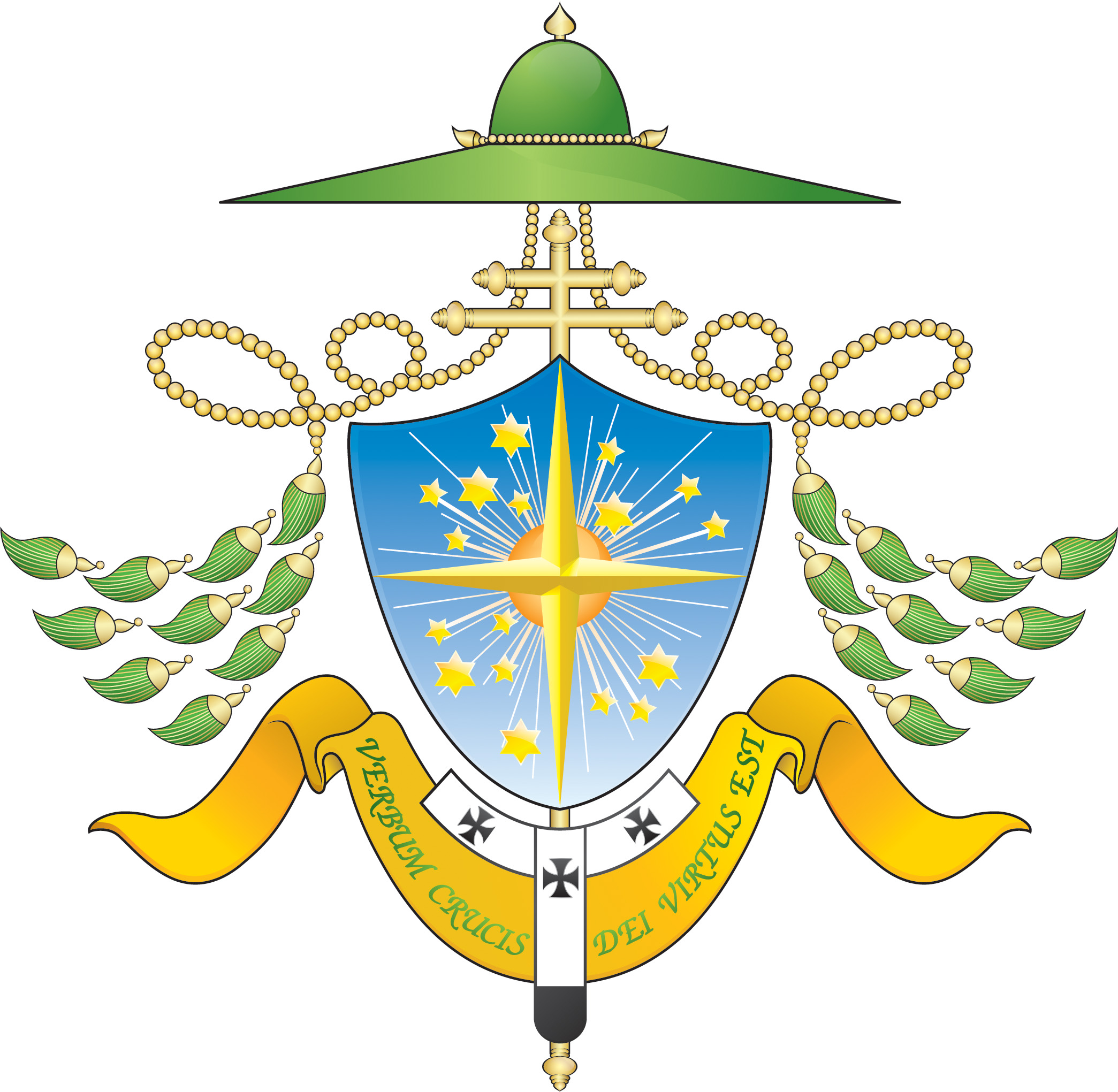
I could not find the full description of the symbols anymore - I remember I saw it once on the website of the diocese of Nakhon Sawan - but I can remember that the stars in the around the central disc symbolize the 13 civil provinces under the diocese. One reason why he cannot use the same symbolism in his new coat of arms as archbishop, because the archdiocese covers one 8 provinces and another two partially. Except the slogan below, everything outside the central shield is the same for all bishops, and varies with the different levels in hierarchy. I have uploaded the SVG-Version into my coding project, but should also upload it to Wikipedia.

Friday, April 3, 2009
Provincial symbol of Prachuap Khiri Khan
 The prime symbol of the province Prachuap Khiri Khan, which is found in its seal as well as in many other places, is a small pavilion located in a cave. Quoting the Kanchanapisek website (sadly only possible via archive.org as the website is mostly empty for some years already and no webmaster notices it):
Prachuap Khiri Khan Province has two places on its seal to indicate its historical importance, namely Kuha Karuhas Pavillion and Lak Isle. The former was built in 1890 on King Rama V's visit within Praya Nakorn Cave, Samroiyord Sub-district and is still there to this day. The latter is located in Prachuap Bay, Muang District.I could visit this pavilion in 2005, and while the pavilion itself is not that impressive, for me the location in the cave illuminated by the sun through the partially collapsed roof of the cave made much more impression than its historic meaning. Thus in the picture I tried to catch the surroundings of the pavilion as well - just too bad that the sun did not shine on the pavilion itself at the time of day I was there.
This pavilion can be found on most of the symbolic items for Prachuap Khiri Khan. Most of all it is of course in the provincial seal, and derived from this also the scouting emblem for the province.


However for the car license plate shown below, only the landscape around that cave is displayed (Gazette). And also a bit surprising, the TAO Sam Roi Yot which contains the cave does not have it on its symbol either.

Friday, November 14, 2008
Municipality and province sharing the same emblem

 The only difference between the two emblems - apart from the writing in the outer circle stating the name of the entity - are the ornamental clouds left and right of the chedi.
 However - actually the temple is not located in the area of the municipality, but instead already belongs to the subdistrict Wiang west of Talad Chaiya, even checking the old announcements of the creation and area changes of the sanitary district Talad Chaiya confirms it never was located within the area of this entity. An interesting question would be at what time the municipality adopted this emblem. Were the sanitary district already eligible of having such an emblem, or only after the sanitary district was elevated to a municipality in 1999? And what happened with the TAO Talad Chaiya, which was incorporated into the municipality in 2004 - did that one have an emblem on its own?
 I can only repeat the question I raised earlier when writing on these emblems the first time for more background information on these emblems...
 Just sad that the TAO Wiang does not show their emblem on their website, it'd be interesting to see if that one also features the same chedi. I even think I passed the TAO office building but missed to ask for a stop there to take a photo. At least a building which looked like that office is on highway 4011 between the temple and the main highway, right where Google Maps places the name Wiang, but we drove too fast for me to read the sign...
Thursday, October 30, 2008
Emblem of TAO San Pu Loei, Doi Saket, Chiang Mai

But what caught my attention was the emblem of the municipality, which unlike most municipal emblems does not show a geographic or historic speciality of the town, but a rather simple graphic. As it is such a simple design, I played with inkscape a bit and made it into a vector graphic, and it came quite close to the one seen on the website.

The emblem shows two hands holding a circle with the three letters อ (Oh Ang), บ (Bo Baimai) and ต (To Tao) - the Thai abbreviation O.Bo.To. which stands for องค์การบริหารส่วนตำบล (Ong Kan Borihan Suan Tambon), in English called Tambon (Subdistrict) Administrative Organization (TAO or SAO). The text in the top arc is องค์การบริหารส่วนตำบลสันปูเลย - TAO San Pu Loei, and in the bottom arc the name of district and province. Though most won't notice, similar calligraphic Thai letters are very commonly seen in Thailand - several of the Royal emblems have the letters Pho Po Ro in middle, the initials of HM the King.
But the work to redraw that emblem was rather in vain, because the TAO has already been upgraded to a subdistrict municipality this summer, and therefore they need to create a new emblem - not only the text in the upper half has to change, but the three letters in the middle have to change. That won't be that easy, as there's no common abbreviation for thesaban tambon (subdistrict municipality), though I rarely have seen ต.ต. used for it. So at least for the center of the emblem they have to come up with a completely new design.
Friday, October 24, 2008
Provincial badges of Thai Scouts

The first page displays the badges of the central, south and western provinces, the second one those of the north, northeast and eastern province. Also notice that there are a total of 12 groups of badges, making up yet another regional subdivision.
There are a few cases where the badge shows a different symbol than the provincial seal - hopefully I catched them all. While for the seals I know the explanation of each symbol (thanks to yet another website of the Paknam school), I have no idea about the alternative symbols yet.
- Phuket - the seal shows the two heroines Thao Thep Kasattri and Thao Sri Sunthon, who saved the island at a Burmese invasion in 1785. The badge however shows a hill which emits light at the top.
- Narathiwat - the seal shows a boat with a white elephant on the sail, commemorating a white elephant once caught in province. The badge shows a forest instead.
- Ratchaburi - the seal shows royal shoes, the badge shows a hill surrounded by a snake.
- Uthai Thani - the seal shows a pavilion at Wat Khao Sakaekrang, the badge a landscape.

Thursday, October 16, 2008
Provincial emblem stamp series, part 3
The third issue of the stamp series with the provincial emblems was published on October 10, this time featuring the emblems of the 10 provinces Pattani, Phra Nakhon Si Ayutthaya, Phang-nga, Phatthalung, Phayao, Phichit, Phitsanulok, Phetchaburi, Phetchabun and Phrae. According to SiamStamp, this issue #856 has a circulation of 900,000 sheets, and 15,000 first day covers. The design of the stamps was done by Udorn Niyomtham of the Thai post, and was printed in the Netherlands. The first day covers should show up on the FDC blog soon as well.
As each issue contains 10 emblems (except the first when they did two sheets at the same time), now 40 out of 76 emblems are covered, and there should be another 4 issues forthcoming - the next should then be in April next year.
As each issue contains 10 emblems (except the first when they did two sheets at the same time), now 40 out of 76 emblems are covered, and there should be another 4 issues forthcoming - the next should then be in April next year.
Subscribe to:
Posts (Atom)