Showing posts with label Phuket. Show all posts

Tuesday, October 23, 2012

Phuket to get a new province hall

The Ministry of Interior will invest 450 million Baht (15 million US$) to build a new province hall in Phuket. The province administration currently still resides in the historical province hall, a wooden building already 103 years old and already a registered monument under the protection of the Fine Arts Department since 1977 [Gazette]. The new building will be located right across the street from the historical building, an area which is currently occupied by tennis courts and the Sanam Chai sports field.
Plans to spend 450 million baht on a new Phuket Provincial Hall took a leap forward this week with the announcement of official approval to clear the 14-rai site on the corner opposite the current building.
Construction of the new center of administration for the island is hoped to begin next year.
Phuket Gazette, Plans unveiled for new, B450mn Phuket Provincial Hall, October 20 2012.
Compared with the historical building which has just two floors, the planned seven stories on a comparable base area seem a bit oversized, but on the other hand I was quite surprised when I walked along the current province hall and wondered how much small it is compared with other province halls, thus it must be very tight on office space inside. The new building is scheduled to take three years to build, thus it will be opened someday in 2016. The old building will then become an ideal location for a historic museum - like the historic province hall of Ratchaburi which now houses a branch museum of the National Museum.

Wednesday, February 22, 2012

Phuket PAO chairmen early election

Last week, Paiboon Upattising (ไพบูลย์ อุปัติศฤงค์), chairman of the Phuket Provincial Administrative Organization (PAO, องค์การบริหารส่วนจังหวัดภูเก็ต) sent a letter of resignation to the province governor. The interesting part is that actually his term in office would have ended in April this year anyway, and he announced that he will run for re-election, so in effect this will separate the chairman election from the PAO council election, as now a new chairman election has to be held within 60 days. The reasons he gave according to Phuket Gazette are
Mr Paiboon added that he preferred the OrBorJor elections to be held early because he foresees delays in holding the elections.
“There are problems with the constituency boundaries because of the imbalance in the increasing number of people in each voting district. The boundaries must be changed to redress this problem before the election can be held, and I have heard of no progress about this,” he said.
So far, no announcement on the PAO constituencies in any of the provinces has been published in the Royal Gazette, except for Buriram which has its election some months earlier than the others anyway. Since the constituencies are only necessary for the council, an election for the chairman can be held without any redefinition of constituencies.
Mr Paiboon cited problems in redrawing constituency boundaries as causing delays in holding elections in both the Rawai and Chalong municipalities.
“They have not had mayors for more than six months. This is causing a lot of problems, and all because of problems in redrawing the constituency boundaries.
“Many important decisions have not been made because the position of the mayor [in Rawai and Chalong] is empty. Election dates have not even been set.” he added.
At least for Chalong, just yesterday the constituencies were announced, with the announcement signed on February 8. Thus now at least for Chalong the municipal election can be finally be held.

It is a bit surprising that due to a slow drawing of constituencies elections can be postponed for many months. Whereas Chalong was just recently upgraded from being a TAO and if the Election Commission wasn't notified in time this could be an explanation for the delay, in case of Rawai there were municipal constituencies defined in 2007 already and it was beforehand known that the four year term will end in 2011 and the constituencies need to be checked at that time.

Anyway, now there will be two elections for the PAO in Phuket this year, and for sure the some expats and tourists especially in Patong will complain bitterly about the two sober weekends - to prevent the voters from going to the ballot intoxicated no alcohol will be on sale in shops and bars all weekend.

Friday, April 22, 2011

Montone Puket - Part II

Whereas the first extract from the 1906 text on Monthon Phuket listed the provinces with their etymology, the following part describes the provincial towns, as well as gives the census data for the area.
Ranong town is divided into four sections and contains a population of about 1,200 souls, mostly Siamese and Chinese. Many of the buildings are tolerably good, many are frail. There is a good court-house building, and the jail is a good brick building, which with its surroundings is kept in most excellent condition. The buildings used for government purposes are all that is desirable. There is a school here well conducted. Many good roads are here kept up.
Takuapa is largely of brick buildings, in fair condition, with much need for more lime as white-wash, and more cleanliness. Here are some good roads, and good well water, with a fine spring flowing from the side of a mountain near by.
Puket has fine government buildings. The roads and city are being improved a good deal. The city has a good market, and the main road is lined on both sides with good substantial brick buildings. There has been here much advance in improvements, for which his Excellency the High Commissioner deserves much credit. Population about 10,000.
Phangnga has good roads, is a brick town and is well kept.
Krabee is well kept, but its buildings are of a frail nature.
Trang town is a comparatively new city, it having been moved from the old site. It has many excellent roads, fine public buildings, a good school-house and clean quarters for prisoners. The High Commissioner is entitled to much credit for improvements and good order here. It should be said also that the steam-boat landing is well kept. Indeed throughout this province are many miles of fine roads.
I should like to add here that in visiting all these and other places in this Montone our treatment and entertainment have always been all that culd be desired, and frequently more than could be expected.
We now come to speak of the inhabitants of this Montone. According to the Bangkok Times of December 11th, 1905, the population of the Montone Puket is 178,599. This is the official census for the year. This census makes the number of Malays 34,903 and Chinese 32,408. Now say the various people aside from those named and the Siamese are 10,000, then there are some 101,288 Siamese in the Montone. A total of 178,599. [...]

Friday, April 1, 2011

Montone Puket - Part I

When my reader Ian explored Phuket recently, one of the locals he talked with showed him a book with some historical texts on Phuket. That book was "Old Phuket", published in 1986 by the Siam Society. While long out of print, luckily my friend hdamm already had one copy which he borrowed me - a physical book is much more comfortable to read than the photos Ian did for me.

The book is in fact a reprint of several articles published in the Journal of the Siam Society 1905 and 1906. The article I will cite is titled Montone Puket (Siam) Malay Peninsula by the missionary John Carrington, which contains a nice description of the provinces within the Monthon Phuket, including a etymology of their names.
It does not lie within the purpose of this paper to discuss the ancient history of this Montone, but to write of it more as it is at the present time, and as observed by the writer during five tours through this region.
This is a portion of Siam, Malay Peninsula, the "Tanah Malayu", or Malay Land. At Kra, กระ, or Kraburee is is about 45 miles wide, and at a line through Junkceylon and Nakhon it is about 200 miles in width.
It will be in place here to name the provinces into which Puket Montone is divided. We begin with the most northerly one and name them on down in their order of location.
1. Ranong - ระนอง - formerly Ranong and Kra. Ranong is said to signify a place of much water; and indeed this is true in the rainy season.
2. Takuapa - ตะ กั่ว ป่า - the place, or wilderness, of lead; named thus, perhaps, because the first tin discovered there was supposed to be lead.
3. Phangnga - พังงา - formerly Takuathoong (lead field) and Phangnga. พังงา undoubtedly means, in this connection, very beautiful, as it will be seen that this province of great beauty - and not Elephant tusk, as some Siamese think.
4. Puket, or Thalang, or Junkceylon. It may be the word puket is the Malay word bukit for hill or mountain. I am not satisfied by this definition. This is a large island separated from the mainland by a very narrow passage of water, and lies south of Phannga. The main town is Tongka - thoongkha - ทุ่งคา, field of grass, or grass field.
5. Krabee - very incorrectly called Gerbee. The Siamese word is กระ บี่ meaning a sword. This is a good Siamese word for that weapon, a lower word being dap, ดาบ, the high word being พระ แสง.
6. Trang, formerly Trang and some other small states. Trang ตรัง is said to mean "adhere" or "joined to." The application I am at loss to discover at the present. It may be that this territory was acquired by the Siamese later than that adjoining it in the North or East, and so was called "joined", that is joined to what they already possessed. This is merely conjecture on my part, and I do not insist.

Friday, March 11, 2011

Lak Mueang of Phuket

Lak Mueang Thaland Tha Ruea
Photo by Ian Reide
In case you follow the comments on this blog as well, you already read that my reader Ian is currently in Phuket exploring, including topics related to my blog. And since he is also fascinated by the city pillar shrines (Lak Mueang, หลักเมือง), he found out why there is no major shrine in the provincial capital like in (most) other provinces.

In Google Maps a city pillar shrine for Phuket can be found way outside the provincial capital, close to the Heroines monument and the Thalang national museum. As it is not as big as those in other provinces, and a bit off the main road, I haven't spotted it myself during the few days I have been on Phuket so far. But I had marked it in my Google Map of the city pillar shrines.

When Ian was now exploring Phuket, he found out that there is not just this one city pillar shrine, but a total of four spread over the island. Actually, those he talked with claimed there are five, but the fifth was nowhere to find. I haven't been able find anything in the net either, for example Kanchanapisek lists only four as well. Quite notably the current photos show those of Choeng Thale very much restored, on Kanchanapisek most have no shrine around them and look quite weathered - the one in Si Sunthon however had a better look in past.

The four city pillars are the following, all located within Thalang district:
Thalang Tha RueaSi Sunthon subdistrictหลักเมืองถลางท่าเรือWaymarking, Kanchanapisek
Thalang Mueang MaiThep Krasattri subdistrictหลักเมืองถลางเมืองใหม่Waymarking, Kanchanapisek
Thalang Pa SakChoeng Thale subdistrictหลักเมืองถลางป่าสักWaymarking, Kanchanapisek
Thalang LephangChoeng Thale subdistrictหลักเมืองถลางเลพังWaymarking, Kanchanapisek


View Lak Mueang in a larger map

Thursday, April 1, 2010

Phuket town or Phuket city?

The newspaper Phuket Gazette had an interesting opinion article last Tuesday titled In defense of Phuket Town on the naming of the municipality in English. Since the municipality was upgraded to the highest municipal status (thesaban nakhon, เทศบาลนคร) in 2004 [Gazette], the technically correct way to name the municipality would be Phuket city. Though I haven't yet found any document by the Royal Institute with recommended translations for the municipality types, it is quite standard to refer to the highest municipal level by the English word "city" - the only one where the translation is not obvious is the thesaban tambon. Yet according to Phuket Gazette, still the predominant naming of the municipality among the English-speaking residents is Phuket town. I guess most of them actually have no idea that there things like the different levels of municipalities, or even at the differences between province, district and municipality, so it will be mostly the nitpickers who have changed their wording after the upgrade. Another problem is the lack of clear definition of town versus city, unlike in German where it has different terms for city levels as well, defined by the International Statistics Conference in 1887.
  • Landstadt (rural town), less than 5,000 citizen
  • Kleinstadt (minor town), 5,000 to 20,000 citizen
  • Mittelstadt (middle town), 20,000 to 100,000 citizen
  • Großstadt (major town), more than 100,000 citizen
However, only Kleinstadt and Großstadt ever made it into the normal spoken German, I read the term Landstadt for the first time today, and also Mittelstadt I only noticed on the German Wikipedia.

Though the definitions differ, in the articles on the Thai districts on the German Wikipedia the above names were used for the municipal levels, only using simply "Stadt" instead of "Mittelstadt". And the word "Kleinstadt" sounds much better than "subdistrict municipality", which seems to be the standard translation for thesaban tambon (เทศบาลตำบล). And there's the even more interesting question - do the citizen of a subdistrict municipality which covers a whole rural subdistrict actually feel they live in anything like a town? Wouldn't a name like "township" or "commune" be more fitting for those subdistrict municipalities which were originally sanitary districts and only cover the more densely populated central areas of a subdistrict, whereas all the TAO now upgraded usually cover a whole subdistrict including vast areas covered by fields, forest or other sparsely unpopulated land.

Wednesday, September 9, 2009

Phuket PAO president cleared of vote-buying allegations

Phuket Gazette reported yesterday that Paiboon Upatising (ไพบูลย์ อุปัติศฤงค์), president of the Phuket provincial administrative organization (PAO) has been cleared of the vote-buying allegations which led to a yellow card issued by the Election Committee (EC) in March.

The decision by the Region 8 appeals court took a bit longer than in the case of Surat Thani PAO president Thani Thaugsuban, who received the yellow card in February. In Surat Thani, a new PAO president was elected already, and Thani stumbled upwards to replace his brother as Member of Parliament in the by-election on August 30.

On the website of the Phuket PAO, one can still read the statement of Paiboon written in March. I guess a new one will be posted there soon. By the way, this website is about the best one from any of the administrative entities I have come across so far - not overloaded with stuff and completely bilingual. I only miss the list of the past PAO presidents in the history section, and a RSS feed to easily follow the news on that site.

Monday, March 30, 2009

Background on the Phuket governor transfer

In the online edition of Phuket News I found an interesting article which gives quite some more background on what happens behind the curtain in the province governor reshuffles.

Dr. Preecha Ruangjan (ปรีชา เรืองจันทร์) had just become governor of Phuket in October last year, and was now transferred to Phitsanulok in northern Thailand. He is replaced by Wichai Phraisa-ngop (วิชัย ไพรสงบ), who was governor in Singburi since October and previously was governor of Phang Nga.

While it would be easy to assume that the whole reshuffle now was only done to revert the reshuffle in October which was still done by the PPP-led Somchai government. But unlike the case of the Chiang Rai governor, in this case one does not need to assume political reasons behind the transfer. The article refers to Mrs Anchalee Vanich Thepabutr (อัญชลี เทพบุตร), former president of the provincial administrative organization (PAO) of Phuket and wife of a member of parliament from Phuket, who states that in fact it was Dr. Preecha himself who requested a transfer, as he has more experience for an agricultural province than for the tourism business which dominates in Phuket.

As a side-effect after the transfer he is now much closer to his home province Phichit, whereas his successor could return to the south after only a few month serving in the central Thai province.

Slightly related: while looking for more links and information on this topic, I also found an interview with Niran Kalayanamit (นิรันดร์ กัลยาณมิตร), who was governor of Phuket 2006-2008.

Friday, June 27, 2008

Local government entities of Phuket province

As Phuket is one of the smallest provinces it's very easy to give a complete listing of the central and local administration divisions in a single posting without becoming too lengthy.
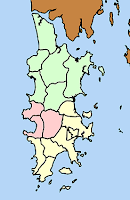
District and subdistricts of PhuketFor the central administration it's three districts, Mueang Phuket (เมืองภูเก็ต), Kathu (กะทู้) and Thalang (ถลาง). These are further subdivided into 17 subdistricts, and 103 villages. Not all of the subdistricts have villages however - Talad Yai and Talad Nuea as part of the city Phuket, and Pa Tong as part of the same-named town don't have this subdivision anymore. I am not sure about Kathu, the city website lists 14 chumchon instead of the 8 muban it had in my latest list.
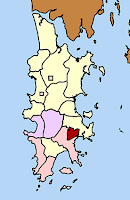
Municipalities and TAO of PhuketThe local government entities are more diverse and has experienced more changes recently. Right now there are nine municipalities, one city (Phuket, ภูเก็ต), two towns (Patong, ป่าตอง and Kathu, กะทู้), and six subdistrict municipalities: Karon (กะรน), Choeng Thale (เชิงทะเล), Thep Krasattri (เทพกระษัตรี), Ratsada (รัษฎา), Rawai (ราไวย์) and Wichit (วิชิต). There are further nine Tambon administrative organizations (TAO).

Originally, Phuket had 13 TAO - of which twelve were created in 1995, and Pa Khlok (ป่าคลอก) in 1996. Karon had been merged into the subdistrict municipality Karon in 2004, and the other three Ratsada, Rawai and Wichit were upgraded into subdistrict municipalities effective August 30 2007.

Of these TAO, Karon, Thep Krasattri and Choeng Thale cover (or covered) only parts of a subdistricts, as the other parts are covered by a municipality. The others cover the complete subdistrict. For the municipalities it's the other way round - Phuket covers two subdistricts, Thep Krasattri and Choeng Thale parts of a subdistrict, and the other six each a whole subdistrict. Originally, when the sanitary district Kathu was created in 1956, it covered only part of the subdistrict Kathu. In 1967 it was enlarged to include the area of Patong, and in 1986 Patong became a separate sanitary district, so since then both cover exactly one subdistrict.

Though I have listed Kathu as a town above, in fact it will become a town effective July 14, as decided into the board meeting 33/2008. Phuket was upgraded to city status in 2004, Patong to town status in 2002.

Phuket was already a town since 1935, the other municipal areas as of today started as either TAO or as one of the five sanitary districts created between 1955 and 1987. Patong was the first of the sanitary districts to be upgraded to a subdistrict municipality in 1994, the other four were upgraded in 1999 when all the sanitary districts of Thailand were upgraded.

Finally, two TAO were created in 1955 - Ratsada and Si Sunthon (ศรีสุนทร) - but I am still not sure yet when this first generation of TAO was abolished again.

So below is a map with those local and central government offices I know so far. I could find two of the TAO with PointAsia, the district offices and those within Phuket city I had looked for quite some time ago to geotag the Wikipedia articles. Any additions or corrections to this map is of course welcome.

View Larger Map