
| Area | Old code | New code |
|---|---|---|
| Mueang Bueng Kan, Bung Khla | 43140 | 38000 |
| Seka | 43150 | 38150 |
| So Phisai | 43170 | 38170 |
| Phon Charoen | 43180 | 38180 |
| Pak Khat | 43190 | 38190 |
| Si Wilai | 43210 | 38210 |
| Bueng Khong Long | 43220 | 38220 |
| Area | Old code | New code |
|---|---|---|
| Mueang Bueng Kan, Bung Khla | 43140 | 38000 |
| Seka | 43150 | 38150 |
| So Phisai | 43170 | 38170 |
| Phon Charoen | 43180 | 38180 |
| Pak Khat | 43190 | 38190 |
| Si Wilai | 43210 | 38210 |
| Bueng Khong Long | 43220 | 38220 |
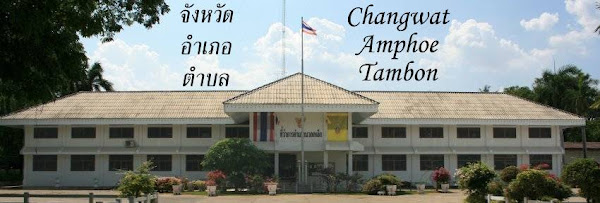
เทศบาลตำบลขุนยวมแบ่งการบริหารงานออกเป็น 8 ชุมชน หรือ 8 ป๊อก คำว่า "ป๊อก" หมายถึง ชุมชน โดยมีการบริหารงานกันเองในชุมชน Khun Yuam subdistrict municipality is divided administratively into 8 boroughs or "pok". The name "pok" means boroughs which have an personal administration in the borough.Rather interesting is also the location of the administrative offices in that subdistrict. Whereas the municipality office is located in the middle of the municipality, a bit strage is the fact the the TAO Khun Yuam has its office just 300 meter away, well within the municipal area (see Panoramio for some photos of it). And, unlike many of the municipalities near the district office, in this case the district office is located outside the municipality - in many cases district office and municipality office are directly next to each other and form the center of the municipality. So I am doing a nice little map again to show the approximate borders of the municipality. Sadly the map in the 1956 announcement to create the sanitary district is more like a sketch map than correctly scaled, so I can only guess that the district office back then was located very close to where it now has the municipality office.
 |
| Khanom District Office, Nakhon Si Thammarat |
| Province Halls | ศาลากลาง | Album |
| District Office | ที่ว่าการอำเภอ | Album |
| Province Court | ศาลจังหวัด | Album |
| Municipal and TAO offices | สำนักงานเทศบาล/สำนักงานอบต | Album |
| PAO offices | สำนักงานอบจ | Album |
| City Pillar Shrines | หลักเมือง | Album |


[...] In fact, Jacquemyns had recommended these since 1892, but he emphasized them again in 1897, along with the significant document known as The Outline of Scheme for the Creation of Municipality of Bangkok.As I know almost nothing about the sanitary district except their names and numbers, even more interesting than the above quoted text are the references given. Especially the 2006 dissertation "Sukhaphiban: Local Administration in Siam 1897-1933" (สุขาภิบาล: การปกครองท้องที่สยาม พ.ศ. 2440-2476) by Maetheepat Jeongwarotai (เมธีพัชญ์ จงวโรทัย) caught my interest, Sadly the only thing in English is the abstract
Accordingly, even King Chulalongkorn agreed with the recommendations, but he worried about these following problems. Firstly, the absence of political participation experience of the Siamese; secondly, that the Siamese may be forced to pay tax alone because the refusal to pay tax by Europeans and Asiatic subjects who claimed extraterritoriality rights; and lastly, it was not suitable to apply at that time. In spite of the fact that there were some arguments, Sukhaphiban was established by The Sanitary Decree of 1897. However, the adoption of participation did not appear in Bangkok at that time, but eight years later came to terms in 1905. The application of local self-governing was known as Sukhaphiban Hua Muang (Sanitary District) at Tha-Chalom District in Samut Sakhon Province, and was called Sukhaphiban Hua Muang Thambon Tha-Chalom, Changwat Samut Sakhon. Two years following, the Act of Sanitary District was enacted in 1908. Throughout the following years, other sanitary districts were formed in certain major cities, and played a significant role in public services at the local level until the end of the absolute monarchy when the act was modified in 1915 and abolished by the Municipal Act in 1933. The sanitary districts during 1915-1933 increased to thirty six districts for 25 years.
The objective of this thesis is to study the evolution of "Sukhaphiban" during 1897-1933. Starting from the reign of King Rama V when Western Colonialism became the most serious threat, the king believed that the promotion of civilization was the only way to prevent the nation from being subjected to 'the White Man's Burden'. Thus he launched "Sukhaphiban", local administration systems led by bureaucrats, to 'civilize' his subjects and towns. During the reigns of King Rama VI and Rama VII, the political situations changed significantly. People in increasing number demanded their basic rights and political participation. Soon, Siamese elites realized that "Sukhaphiban" no longer matched the demand. There was a wide discussion among the elites about the idea of "Municipality" a system that would allow local citizens to elect their own representatives. Nevertheless, it was only after the 1932 revolution that this system was truly introduced and implementedThanks to a friend working in a Thai university I have the full text of the dissertation now, but as it is a scanned PDF I really have to read it and cannot do the shortcut through Google Translate - so it will take quite long until I can post any interesting details I learned from that dissertation.
 Somehow I totally missed that DOPA had updated their list of numerical codes already to include the codes for Bueng Kan province and its subdivisions. Though I already guessed that the province will get the code 38, and quite logically the Mueang Bueng Kan district will get the 3801, I had to wait for the list to have the codes for all other districts, subdistricts and the municipalities.
| Name | Type | Old code | New code |
|---|---|---|---|
| Bueng Kan | Province | 38 | |
| Mueang Bueng Kan | District | 4303 | 3801 |
| Bueng Kan | Subdistrict | 430301 | 380101 |
| Non Sombun | Subdistrict | 430303 | 380102 |
| Non Sombun | Subdistrict | 430303 | 380102 |
| Nong Kheng1 | Subdistrict | 430304 | 380103 |
| Ho Kham | Subdistrict | 430305 | 380104 |
| Nong Loeng | Subdistrict | 430306 | 380105 |
| Khong Kong | Subdistrict | 430307 | 380106 |
| Na Sawan | Subdistrict | 430310 | 380107 |
| Khai Si | Subdistrict | 430311 | 380108 |
| Chaiyaphon | Subdistrict | 430314 | 380109 |
| Wisit | Subdistrict | 430316 | 380110 |
| Kham Na Di | Subdistrict | 430318 | 380111 |
| Pong Pueai | Subdistrict | 430319 | 380112 |
| Phon Charoen | District | 4304 | 3802 |
| Si Chomphu | Subdistrict | 430401 | 380201 |
| Don Na Yang | Subdistrict | 430402 | 380202 |
| Phon Charoen | Subdistrict | 430403 | 380203 |
| Nong Hua Chang | Subdistrict | 430404 | 380204 |
| Waeng Chomphu | Subdistrict | 430405 | 380205 |
| Pa Faek | Subdistrict | 430406 | 380206 |
| Si Samran | Subdistrict | 430407 | 380207 |
| So Phisai | District | 4306 | 3803 |
| So | Subdistrict | 430601 | 380301 |
| Nong Phan Tha | Subdistrict | 430602 | 380302 |
| Si Chumphu | Subdistrict | 430603 | 380303 |
| Kham Kaeo | Subdistrict | 430604 | 380304 |
| Bua Thum | Subdistrict | 430605 | 380305 |
| Tham Charoen | Subdistrict | 430606 | 380306 |
| Lao Thong | Subdistrict | 430607 | 380307 |
| So Phisai | District | 4306 | 3803 |
| Seka | District | 4309 | 3804 |
| Seka | Subdistrict | 430901 | 380401 |
| Sang | Subdistrict | 430902 | 380402 |
| Tha Kok Daeng | Subdistrict | 430903 | 380403 |
| Ban Thong | Subdistrict | 430906 | 380404 |
| Pong Hai | Subdistrict | 430907 | 380405 |
| Nam Chan | Subdistrict | 430908 | 380406 |
| Tha Sa-at | Subdistrict | 430909 | 380407 |
| Nong Thum | Subdistrict | 430912 | 380408 |
| Sok Kam | Subdistrict | 430913 | 380409 |
| Pak Khat | District | 4310 | 3805 |
| Pak Khat | Subdistrict | 431001 | 380501 |
| Nong Yong | Subdistrict | 431002 | 380502 |
| Na Kang | Subdistrict | 431003 | 380503 |
| Non Sila | Subdistrict | 431004 | 380504 |
| Som Sanuk | Subdistrict | 431005 | 380505 |
| Na Dong | Subdistrict | 431006 | 380506 |
| Bueng Khong Long | District | 4311 | 3806 |
| Bueng Khong Long | Subdistrict | 431101 | 380601 |
| Pho Mak Khaeng | Subdistrict | 431102 | 380602 |
| Dong Bang | Subdistrict | 431103 | 380603 |
| Tha Dok Kham | Subdistrict | 431104 | 380604 |
| Si Wilai | District | 4312 | 3807 |
| Si Wilai | Subdistrict | 431201 | 380701 |
| Chumphu Phon | Subdistrict | 431202 | 380702 |
| Na Saeng | Subdistrict | 431203 | 380703 |
| Na Sabaeng | Subdistrict | 431204 | 380704 |
| Na Sing | Subdistrict | 431205 | 380705 |
| Bung Khla | District | 4313 | 3808 |
| Bung Khla | Subdistrict | 431301 | 380801 |
| Nong Doen | Subdistrict | 431302 | 380802 |
| Khok Kwang | Subdistrict | 431303 | 380803 |
| Ho Kham | Municipality | 4377 | 3887 |
| Nong Kheng | Municipality | 4379 | 3888 |
| Wisit | Municipality | 4380 | 3889 |
| Si Wilai | Municipality | 4383 | 3890 |
| Bueng Khong Long | Municipality | 4384 | 3891 |
| Pak Khat | Municipality | 4385 | 3892 |
| Si Phana | Municipality | 4386 | 3893 |
| Tha Sa-at | Municipality | 4387 | 3894 |
| So Phisai | Municipality | 4390 | 3895 |
| Phon Charoen | Municipality | 4392 | 3896 |
| Don Ya Nang | Municipality | 4393 | 3897 |
| Bueng Kan | Municipality | 4394 | 3898 |
Municipal bureaucrats expect implementation of a special administration zone at Mae Sot to help restructure taxes so they contribute more to public services and oversight of migrant workers.
They hope the change - backed by major political parties in the capital but yet to be approved - will boost the business revenue in the area from Bt2030 billion to Bt100 billion, and help turn Mae Sot into a model city.
[...]
"Currently, government policies are uncoordinated and not unified," the mayor [Teardkiat Shinsoranan of Mae Sot] said.
"Municipal and provincial officials all think and act on their own, with their limited budget," he complained.
As a result, no one was able to handle bigger problems that required bigger budgets and regional coordination.
[...]
Technically, two special zones are proposed - a Special Local Administrative Zone and a Special Economic Zone.
[...]
Mae Sot municipality's website notes that the House of Representatives last met on April 4, to read and correct details in a draft law in create these bodies. Involved parties are now waiting for the new government to finalise the bill.
"Both Thaksin and Abhisit's governments agreed to this project," said Chaiwat, who hoped that Yingluck's administration would also support it.
Next economic boom site?, The Nation, 2011-08-15
But the position of village or district head _ lower in the steep vertical abyss that is the Thai political structure though it may be _ is secure and, if you play it right, very lucrative.Now as far as I knew, the headmen had their term changed to five years around the adoption of the 1997 constitution, so the life-time terms were a piece of the past.
The village or district head is only elected once and his or her term lasts until the day he or she retires, at 60 years of age. It's pretty much a life-time job. Not to mention, they get better benefits and sometimes better pay.
Why and how have we come to this?But as the author claims that there was a recent change in the law, I had to look more close into it. The roles of the headmen are codified in the Local Administration Act (พระราชบัญญัติลักษณะปกครองท้องที่), originally from 1914 [Gazette] and amended 11 times since then. And the most recent amendment was announced December 30 2009 [Gazette], so it'd fit to the law referred to above. Alas, this only adds one sentence to the law
The particular law responsible came into effect on Dec 31, 2009, but it was passed in 2007.
การยกเลิกตำแหน่งกำนัน ผู้ใหญ่บ้าน แพทย์ประจำตำบล สารวัตรกำนัน และผู้ช่วยผู้ใหญ่บ้าน จะกระทำมิได้This refers to the cancellation of these positions when the subdistrict gets elevated to a municipality, where these officials were originally considered obsolete. This amendment might have been added due to the protest of the outgoing headmen on Ko Samui, when the island was upgraded to a town in 2008. But this change does not say anything about the term of the headmen.
Cancellation of the position of subdistrict headman, village headman, village doctor, district inspector and assistant headmen shall not be made.
ผู้ใหญ่บ้านอยู่ในตำแหน่งคราวละห้าปี นับแต่วันที่ราษฎรเลือกAnd now amendment 11, issued in 2008 and therefore legislated by the coup group of 2006, changed this article 13 completely again, so now a village headmen leaves office only due to the reasons stated in article 14, most notable item 1
The term of the village headman is five years, starting from the day of the election.
มีอายุครบหกสิบปีI haven't looked up the same item for the subdistrict headmen yet, but as the commentator claims these are also now effective life-time positions I have no reason to disbelief him.
When aged 60.
 |
| Screenshot of a Wikipedia article on a Thai district |
Tha Mae Lop (Thai: ?) is a village and tambon (subdistrict) of Mae Tha District, in Lamphun Province, Thailand. In 2005 it had a total population of 3032 people. The tambon contains 6 villages.Everything in these two sentences is just what is written in the table in the article on Mae Tha district - population, administrative villages and obviously the location. But already the reference to ThaiTambon.com within the article points on the base page instead to the page on this specific Tambon, and even the Thai spelling wasn't copied. Even worse was the one on Nai Mueang subdistrict - it was a similar short article on the subdistrict of Mueang Lamphun district, though in fact there are 23 subdistrict with that name all over Thailand.
 As the new parliament convened on August 1st with all 500 members endorsed by the Election Commission - only two had to go through a by-election due to a yellow card after irregularities in the first round - now is a good time to round up the coverage on constituencies for this election.